Virtual Machines in Iraq: Building Scalable Digital Businesses with Linkdata.com
What If Your Next Server Didn’t Need to Be a Physical Server?
Imagine launching a new business application in Baghdad without purchasing a physical server, installing networking equipment or building a dedicated server room.
Imagine a software development company in Erbil creating separate computing environments for every project without investing in additional hardware.
Or an enterprise in Basra expanding its computing resources without waiting for new equipment to arrive.
This is the advantage of virtual machines.
The growing demand for virtual machines in Iraq reflects a fundamental change in how businesses purchase, deploy and manage technology.
Instead of building expensive physical IT environments, organisations can access virtual computing resources through cloud infrastructure.
Linkdata.com brings virtual machine hosting to businesses across Kurdistan, Iraq and global markets, enabling organisations to build scalable digital environments using professionally operated cloud infrastructure.
What Is a Virtual Machine?
A virtual machine, commonly known as a VM, is a software-defined computer that operates within a physical computing environment.
Although it does not exist as an independent physical device, a virtual machine functions much like a traditional computer or server.
Each virtual machine can have its own:
- Virtual central processing units (vCPU).
- Random access memory (RAM).
- Operating system.
- Virtual storage.
- Network interfaces.
- IP address, depending on its network configuration.
- Applications and software.
- Security and access configurations.
Virtual machines can operate independently from other virtual environments running on the same physical infrastructure.
This allows cloud providers to use physical computing resources efficiently while delivering separate environments to different customers.
For businesses in Iraq, virtual machines provide an alternative to purchasing and maintaining individual physical servers.
How Do Virtual Machines Work?
Virtual machines operate through a technology known as virtualisation.
A software layer called a hypervisor manages the relationship between physical hardware and virtual computing environments.
The hypervisor allocates computing resources to individual virtual machines and maintains separation between their operating environments.
For example, a single physical server could theoretically contain 64 CPU cores and 256 GB of RAM.
Its computing resources could be distributed across multiple virtual machines according to their requirements, allowing different applications to operate independently.
One virtual machine might run an e-commerce platform, another might manage a database, while another could provide a software development environment.
Each environment has its own operating system and configuration.
This approach allows organisations to separate workloads without purchasing separate physical servers for every application.
Virtual Machines in Iraq: Why Local Hosting Matters
For many Iraqi businesses, purchasing computing infrastructure historically meant either investing in physical hardware or renting servers located outside the country.
The development of domestic cloud infrastructure provides another option.
Businesses can now evaluate virtual machine hosting within Iraq according to their technical and commercial requirements.
Hosting virtual machines in Iraq can offer several potential advantages:
- Reduced geographical distance between applications and Iraqi users.
- Greater flexibility over where business information is hosted.
- Access to technical expertise familiar with the local market.
- Reduced dependence on privately operated server rooms.
- Infrastructure options for businesses with domestic hosting requirements.
- Opportunities to expand computing resources as applications grow.
Actual application performance depends on network routing, connectivity, server configuration and software architecture.
However, for businesses primarily serving Iraqi customers, domestic virtual machine hosting is an important option to consider.
Linkdata.com: The Infrastructure Behind Iraq’s Virtual Machines
Virtual machines may exist as software-defined environments, but their performance ultimately depends on physical infrastructure.
Every virtual CPU, memory allocation and storage volume relies on real hardware operating inside a data center.
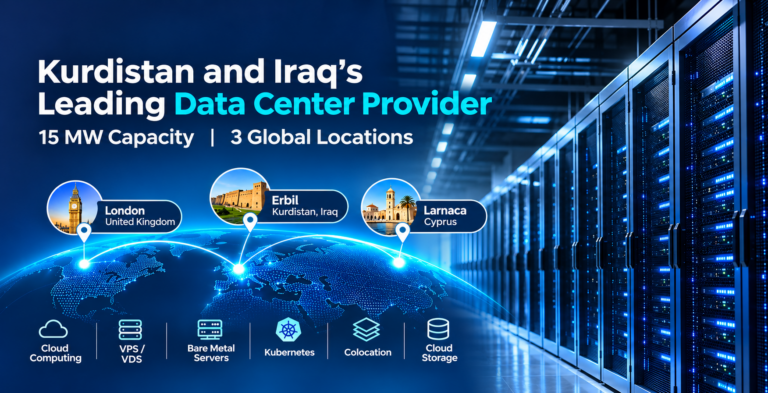
Linkdata.com combines virtual computing services with its own Iraqi data center infrastructure in Erbil, Kurdistan Region of Iraq.
Its large-scale data center development, with a stated capacity of 15 MW and 2,000 server racks, provides a foundation for supporting enterprise hosting and virtualised computing environments.
Linkdata.com also maintains an international infrastructure presence in London, United Kingdom, and Larnaca, Cyprus.
This combination connects Iraqi cloud computing with international hosting opportunities, allowing businesses to evaluate virtual infrastructure according to their geographical and operational requirements.
Not All Virtual Machines Are Created Equal
Two virtual machines with identical advertised specifications can deliver significantly different performance.
A virtual machine advertised with four vCPUs and 16 GB of RAM does not necessarily perform identically to another virtual machine with the same specifications.
Several factors influence actual performance.
CPU Allocation
Some cloud providers allocate more virtual CPU resources than the underlying physical hardware can simultaneously deliver.
This practice is known as CPU oversubscription.
Although resource sharing can improve infrastructure efficiency, excessive oversubscription may lead to inconsistent performance during periods of high demand.
Linkdata.com advertises virtual private servers without CPU core or RAM oversubscription.
This approach is particularly relevant for businesses that require predictable computing resources for demanding applications.
Memory Allocation
Available RAM influences how efficiently applications, databases and operating systems can operate.
Insufficient memory can cause applications to slow down or rely excessively on storage-based virtual memory.
Selecting appropriate RAM capacity is therefore essential when deploying virtual machines.
Storage Performance
Storage capacity alone does not determine performance.
Businesses should also consider read and write speeds, storage latency and input/output operations per second.
Linkdata.com offers persistent SSD-based or SAN storage options within its virtual server portfolio.
Network Connectivity
A powerful virtual machine may still deliver poor application performance if its network connectivity is unsuitable.
Bandwidth, routing, latency and packet loss can all influence the user experience.
For Iraqi businesses, selecting infrastructure with suitable network connectivity is just as important as choosing CPU and memory specifications.
Virtual Machines vs Physical Servers
Businesses considering infrastructure modernisation often need to decide between virtual machines and physical servers.
| Feature | Virtual Machines | Physical Servers |
|---|---|---|
| Hardware ownership | Generally provided by the cloud provider | Owned or rented as dedicated hardware |
| Deployment | Typically faster | May require hardware provisioning |
| Resource flexibility | Configurable according to available plans | Limited by installed hardware |
| Initial investment | Generally lower when rented | Can be higher when purchased |
| Hardware maintenance | Managed by the infrastructure operator | Depends on ownership and service agreement |
| Operating system | Independent virtual environment | Runs directly on hardware or through virtualisation |
| Scalability | Flexible within platform capabilities | May require hardware upgrades |
| Suitable workloads | Websites, applications, databases and development | Specialised and hardware-intensive workloads |
Virtual machines are particularly attractive for businesses requiring flexibility without the complexity of managing physical equipment.
However, dedicated physical infrastructure remains valuable for organisations requiring specialised hardware, direct hardware access or particular performance characteristics.
Linkdata.com offers both virtual and dedicated computing services, allowing businesses to select infrastructure according to their requirements.
Virtual Machines vs VPS: What Is the Difference?
The terms virtual machine and Virtual Private Server are frequently used interchangeably, but they describe slightly different concepts.
A virtual machine is the underlying virtual computing environment created using virtualisation technology.
A VPS is a commercial hosting service that typically provides customers with access to an isolated virtual server environment.
In practical terms, a VPS is often delivered as a virtual machine configured for server hosting.
Businesses requiring a single application server may choose VPS hosting.
Organisations building more complex environments may require multiple virtual machines connected through virtual networking and supported by additional storage and security configurations.
Understanding this distinction helps businesses select the appropriate infrastructure rather than purchasing computing resources based on terminology alone.
What Can Businesses Run on Virtual Machines?
The flexibility of virtual machines makes them suitable for a wide range of business applications.
ERP Systems
Enterprise Resource Planning platforms help businesses manage finance, procurement, inventory, human resources and other operational processes.
Virtual machines can provide computing environments for ERP applications and their supporting databases.
CRM Platforms
Customer Relationship Management systems require dependable access to customer information, sales records and business workflows.
A virtual machine can provide an independent environment for deploying and managing CRM software.
E-Commerce Platforms
Online retailers across Iraq require infrastructure capable of processing customer orders, displaying products and managing inventory.
Virtual machines can support online stores, application servers, payment integrations and associated databases.
Database Servers
Businesses can deploy separate virtual machines for database management systems such as MySQL, PostgreSQL or Microsoft SQL Server, subject to operating system and licensing requirements.
Separating application and database environments can improve operational control and simplify certain maintenance activities.
Software Development and Testing
Development teams can create separate virtual environments for building, testing and deploying applications.
This reduces the risk of experimental software changes affecting production systems.
Mobile Application Backends
Many mobile applications depend on servers for user authentication, notifications, application programming interfaces and data storage.
Virtual machines provide configurable computing environments for these backend services.
Educational Platforms
Universities, training providers and educational technology companies can use virtual machines to host learning management systems, online assessments and digital educational resources.
From One Virtual Machine to an Entire Virtual Data Center
A growing business may initially require a single virtual machine.
However, as its applications become more sophisticated, its infrastructure requirements may change.
Consider an Iraqi e-commerce company.
During its early stages, it may operate its website, application and database on one virtual server.
As customer numbers grow, the company may separate these components into multiple environments.
Its architecture could eventually include:
- Two application virtual machines.
- A dedicated database virtual machine.
- A separate development environment.
- A testing and staging environment.
- A monitoring server.
- A backup storage environment.
- A load balancer distributing incoming requests.
Instead of depending on one server, the business now operates an interconnected cloud computing environment.
This is where virtual data center architecture becomes increasingly valuable.
A virtual data center combines virtual computing, networking and storage resources into a more comprehensive infrastructure environment.
Depending on the platform and service configuration, organisations can design environments around their own technical requirements rather than treating every virtual server as an isolated hosting product.
Virtual Machines for Startups in Iraq
Launching a technology startup requires investment in product development, employees, marketing and customer acquisition.
Purchasing physical servers before a business has established its customer base can create unnecessary financial pressure.
Virtual machines provide an alternative.
A startup in Baghdad could deploy its application backend on a cloud VM.
A software company in Sulaymaniyah could create separate development and production environments.
A technology business in Erbil could start with modest computing resources and expand as demand increases.
This gives entrepreneurs greater control over infrastructure expenditure while allowing them to focus on building their products.
Linkdata.com’s virtual server services provide computing options for businesses at different stages of development.
Enterprise Virtualisation Across Iraq
Virtualisation is not limited to startups and software developers.
Established organisations can use virtual machines as part of broader infrastructure modernisation strategies.
Banks, telecommunications providers, universities, healthcare organisations, logistics companies and commercial enterprises may operate numerous applications with different computing requirements.
Instead of maintaining individual physical servers for every system, organisations can evaluate virtualised infrastructure.
Potential benefits include more efficient resource utilisation, simplified hardware management and greater flexibility when deploying applications.
For regulated organisations, virtualisation decisions must also account for security, compliance, data protection and business continuity requirements.
Linkdata.com provides virtual and dedicated infrastructure options for enterprises evaluating these requirements.
Virtual Machine Hosting Across Iraqi Cities
Businesses do not need to be located physically beside a data center to use virtual machines.
Linkdata.com’s Iraqi infrastructure provides remotely accessible computing services for businesses across the country, including:
- Baghdad, Fallujah, Ramadi and Baqubah.
- Basra, Nasiriyah, Amarah and Kut.
- Mosul, Kirkuk, Tikrit and Samarra.
- Najaf, Karbala, Hillah, Diwaniyah and Samawah.
- Erbil, Sulaymaniyah, Duhok, Halabja, Zakho and Soran.
Whether an organisation operates in the Kurdistan Region, central Iraq or the southern governorates, cloud virtual machines provide an opportunity to access computing resources without maintaining all physical infrastructure locally.
Businesses expanding internationally can also evaluate Linkdata.com’s international hosting presence in London and Larnaca.
Linux and Windows Virtual Machines
Operating system selection is an important part of deploying a virtual machine.
Linux Virtual Machines
Linux-based virtual machines are commonly used for web servers, databases, application development, automation and containerised workloads.
Popular Linux distributions include Ubuntu, Debian, Rocky Linux and AlmaLinux.
Linux environments are particularly relevant for developers working with PHP, Python, Node.js and other modern application technologies.
Windows Virtual Machines
Windows-based environments are commonly used for Microsoft-dependent applications, Windows Server workloads, enterprise software and certain remote desktop configurations.
Businesses using Windows virtual machines should consider operating system licensing, application licensing and resource requirements.
The availability of specific operating systems and licensing arrangements should be confirmed when selecting a hosting plan.
Virtual Machines and Cloud Security
Virtualisation provides logical separation between computing environments, but it does not automatically protect every application from security threats.
Businesses operating virtual machines should implement appropriate security practices, including:
- Operating system and application updates.
- Secure authentication and access management.
- Firewall configuration.
- Restricted administrative access.
- Regular backups.
- Monitoring and security logging.
- Encryption where appropriate.
- Tested recovery procedures.
Cloud security is a shared responsibility.
The infrastructure provider manages the underlying services according to its contractual responsibilities, while customers must ensure that their applications and operating environments are configured securely.
How to Choose the Right Virtual Machine
Selecting a virtual machine should begin with understanding the application rather than simply purchasing the cheapest available server.
The following configurations illustrate potential starting points for different workloads.
| Workload | Example vCPU | Example RAM |
|---|---|---|
| Small website | 2 | 4 GB |
| Business web application | 2–4 | 4–8 GB |
| CRM or ERP application | 4–8 | 8–16 GB |
| E-commerce platform | 4–8 | 8–32 GB |
| Database server | 8–16 | 16–64 GB |
| Enterprise application | 8–32+ | 32–128+ GB |
These are illustrative configurations rather than fixed requirements or specific Linkdata.com packages.
Actual sizing should consider concurrent users, application architecture, database size, storage performance and software requirements.
Businesses can begin with a suitable environment, monitor resource utilisation and evaluate upgrades when required.
Why Choose Linkdata.com for Virtual Machines in Iraq?
Linkdata.com combines virtualisation technology, domestic infrastructure and international hosting options to support businesses with different computing requirements.
Its approach brings together:
- Iraqi data center infrastructure.
- Virtual server hosting without advertised CPU core or RAM oversubscription.
- Persistent SSD-based and SAN storage options.
- Flexible computing configurations.
- VPS and dedicated server solutions.
- Kubernetes and enterprise infrastructure services.
- A stated data center development capacity of 15 MW and 2,000 server racks.
- Three strategic locations in Erbil, London and Larnaca.
For businesses seeking virtual machines in Iraq, Linkdata.com provides an opportunity to build computing environments using infrastructure rooted in the Iraqi market.
From a single virtual server to more sophisticated enterprise infrastructure, businesses can evaluate solutions according to their individual technical requirements.
Frequently Asked Questions About Virtual Machines in Iraq
Can I rent a virtual machine in Iraq?
Yes. Linkdata.com provides virtual server hosting through its Iraqi cloud infrastructure, allowing businesses and developers to access remotely hosted computing environments.
What is the difference between a virtual machine and a physical server?
A virtual machine operates within a software-defined computing environment, while a physical server is an actual hardware device. Multiple virtual machines can operate on one physical server.
Can I host a website on a virtual machine?
Yes. Virtual machines can host websites, databases, web applications, APIs and other online services.
Are virtual machines suitable for enterprise applications?
Yes. Appropriately configured virtual machines can support enterprise applications, ERP systems, CRM platforms and databases.
Does Linkdata.com oversubscribe CPU and RAM resources?
Linkdata.com’s VPS service page states that its virtual servers do not use CPU core or RAM oversubscription.
Can I use virtual machines outside Iraq?
Yes. Virtual machines can be accessed remotely through suitable network connections. Linkdata.com also maintains an international presence in London and Larnaca.
Are virtual machines automatically backed up?
Not necessarily. Backup availability, frequency, retention and recovery procedures depend on the hosting service and configuration selected. Businesses should confirm these arrangements before deploying critical applications.
Can I increase the resources of my virtual machine?
Virtual hosting generally provides options for upgrading computing resources. Available configurations, upgrade procedures and potential service interruptions depend on the provider and hosting plan.
The Future of Computing in Iraq Is Virtual
The next generation of Iraqi businesses will not necessarily depend on rooms filled with physical servers.
They will depend on flexible computing environments capable of supporting applications, databases, automation and increasingly sophisticated digital services.
Virtual machines are a fundamental building block of this transformation.
They allow businesses to consume computing resources according to their requirements rather than investing in physical equipment for every new project.
Linkdata.com is contributing to this transformation through its Iraqi data center infrastructure, virtual computing services and international presence.
From Baghdad to Erbil, Basra to Mosul, and Kurdistan to global markets, businesses can build their digital operations using infrastructure designed to support evolving computing requirements.
Your next server doesn’t need to take up physical space in your office. It can be a virtual machine powered by Linkdata.com.
Explore virtual machines, cloud servers and enterprise computing solutions at Linkdata.com.